BRASIL-EUROPA
GLOBAL STUDIES
CULTURE/NATURE

BRASIL-EUROPA
GLOBAL STUDIES
CULTURE/NATURE
São Paulo. Baroque Festival 1968
Global Studies: Culture/Nature
1968
Studies of cultural processes in global contexts
using Euro-Brazilian relations as a frame of reference

São Paulo
São Paulo, Santos, Bragança Paulista, Atibaia, Itu, Santana do Parnaíba, Pirapora do Bom Jesus, Salto, Campinas, Jundiaí, Mogí Guaçú, Mogi das Cruzes, Taubaté, Santa Isabel, Pindamonhangaba, Guaratinguetá, São Luís do Paraitinga, Lagoinhas, Cunha, Cotia, Carapicuiba
Minas Gerais
Camanducaia, Poços de Caldas, Machado, Caldas, Andradas, Alfenas, Antonio Carlos, Baependi, Santa Rita do Passa Quatro, Cambuquira, Passos
Arrte e ComArt and Communication | Design and Cultural Studies | Mass Communication | Information Theory | Visual Arts and Music | Avant-garde | Paulista Musicology | Center for Musicological Research | Archive and Collection Research | Studies of the Paraíba Valley | Studies of the Middle Tietê Region | New Diffusion Encounters | Encounter in Passos, Minas Gerais | Madrigal das Arcadas | Founding of the New Diffusion Society | Encounters in Conservatories | Renewal of Music Education | Colloquia at the Leopoldo Fróes Theater | Colloquia at the Municipal Theater | Meeting at the Department of Culture of São Paulo | Cultural Diffusion in Neighborhoods | Contemporary Music in Higher Education | Japanese-Brazilian Studies | Colloquia at the Bach Society of São Paulo | History of Art, Aesthetics in Architecture and Music | Architectural Acoustics and Music | Contemporary Art and Contemporaneity | Revisions of the Baroque | Baroque and Colonialism |
Research on 18th-century music in Brazil and the Baroque in global contexts | Bach-Brazil and revisions of perspectives from the Bach Society | History of music in Portugal in the 18th century | Italy-Brazil | Germany-Brazil | Czechoslovakia-Brazil |
* * *
1968 was a landmark in the development of cultural studies based on music, initiated by the Nova Difusão (ND) movement launched in São Paulo in 1965. It continued the reflections, studies, and initiatives of 1967, which were guided primarily by an interest in contemporary issues in the arts and cultural studies, as well as musicological research, particularly the history of music in colonial America and its insertions in global contexts.
1968 was a year marked not only in São Paulo by impulses of renewal, a yearning for the new, and the overcoming of structures, situations, and perspectives felt to be outdated, retrograde, or inert. Discussions, revolts, and protests, including the Vietnam War, the Prague Spring, the assassinations of Martin Luther King and Robert Kennedy, but also political situations of oppression and restrictions in Brazil under the military regime motivated revolts among youth, intellectuals, and artists. The search for renewal in every sense led to the pursuit of new directions in studies and the arts. Structures perceived as reactionary in universities, in cultural and musical life, and in societal and moral conventions began to be criticized.
In Brazil, too, the year 1968 was marked not only by student uprisings and political protests, but also by actions, initiatives, and projects in cultural and musical life that signaled youthful renewal and a new beginning, shaping the decades to come. São Paulo was one of the most important centers of this ferment and these actions. It manifested itself most obviously in popular music, but affected all other areas of musical and cultural life, the creation and thought of progressive intellectuals. It was the year of coming of age for many young musicians, artists, and students—and, in a broader sense, thinkers of all ages—who had felt a restlessness for renewal for years.
A significant center of student unrest and intellectual ferment was the University of São Paulo, particularly the Faculty of Arts and the Faculty of Architecture and Urbanism. Both gave rise to political actions and creative impulses that shaped the social and cultural life of the city. Since both faculties were still located close to the city center – a situation that would change in 1969 with their relocation to more remote campuses – they shaped the life of a student quarter with its experimental theaters, cinemas, galleries, and bars. They were crucial for São Paulo's continued existence as a university city, which, as the seat of the venerable law faculty dating back to the first decades of the 19th century, was characterized before industrialization by students coming from all parts of Brazil.
The Faculty of Architecture was particularly well-suited to this pursuit of overcoming rigidity and embracing the new, as it itself was driven by the search for a new, distinct identity and the dynamic interplay between the tradition of engineering and the tradition of the fine arts. These aspirations and perspectives shaped the orientation within the fields of art history and aesthetics, design, and visual communication. The interdisciplinary approach of architectural studies fostered creative engagement with theater and art, and especially with music. In the years prior, an architecture student had been one of Brazil's most famous popular singers, Francisco Buarque de Holanda. Music permeated student life and was enriched by reflections on the relationship between architecture and music, a theme furthered by the Department of Architectural Acoustics. 1968 marked the beginning of a program for studying the reciprocal relationships and interferences between music, architecture, and urban planning, a program that would continue for decades. Initiatives originating from the field of architecture influenced music studies and activities.
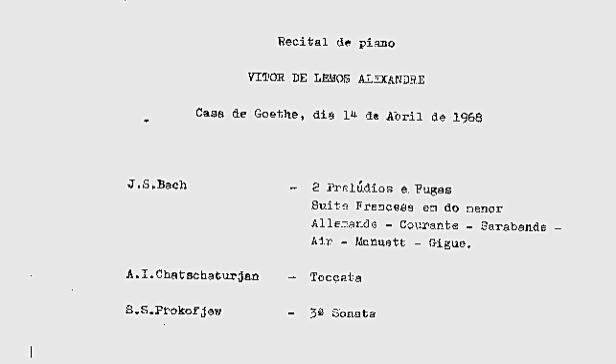
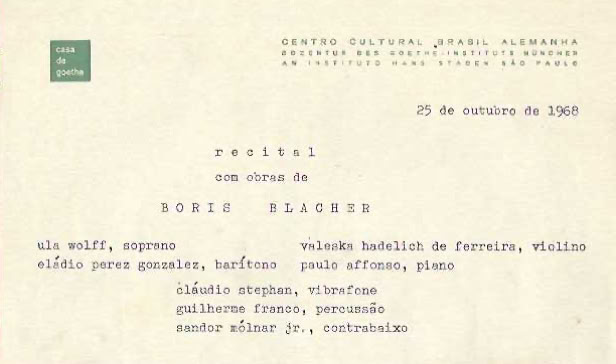
1968 represents a milestone in the development of cultural studies in transnational contexts conducted from the perspective of music and musicology oriented towards cultural processes. Reflections within the ND movement corresponded to an interest in contemporary musical studies at the time, manifested in events at various institutions. Among these, those at the Goethe House stood out, such as the recital by Vitor Alexandre on April 1st. Significant was the interest in Boris Blacher within contemporary music circles in São Paulo. A landmark event was a recital of works by the composer organized by Paulo Affinso de Moura Ferreira on October 25th and promoted by the Brazil-Germany Cultural Center. The pianist, a collaborator of the ND movement, gave a recital of Contemporary Music for the Brazil-United States Cultural Union on October 6th, in which he considered both Brazilian and American composers. Special mention should be made of the continued relations with Japanese circles in São Paulo, initiated in 1964 and marked in 1968 by concerts commemorating the Foundation's tenth anniversary on June 1st, with the first performance in Brazil of a work by Yazuji Kyiose and works composed by young members of the ND board.
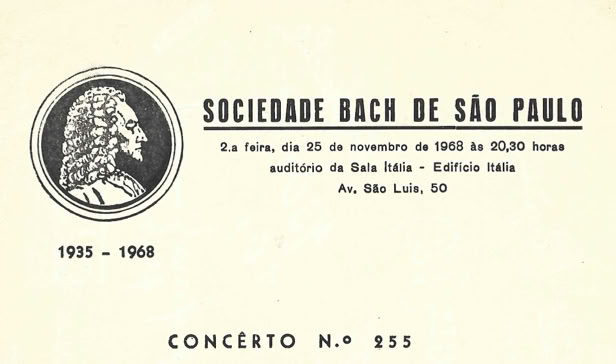
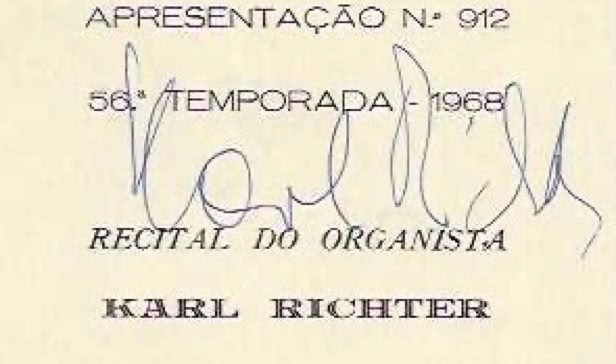
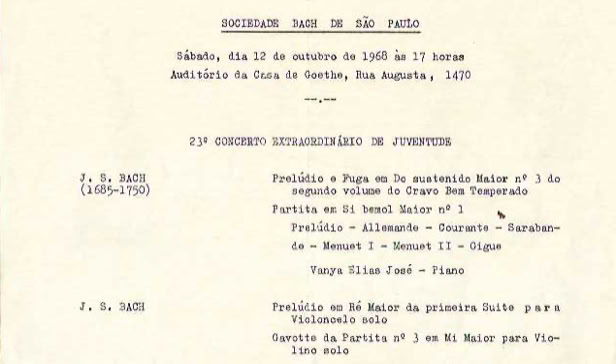
On October 12th, the 23rd Extraordinary Youth Concert of the Bach Society of São Paulo took place, featuring works by Bach, Scarlatti, Vivaldi, and Marcello, a landmark in the study of Bach's reception in Brazil and in collaborations with Renata Braunwieser. A high point in Bach-Brazil studies and organ art was the recital and dialogues with Karl Richter during a concert at the São Bento Monastery on August 22nd. An important event for the study of Bach-Brazil relations and the reception of Bach in Brazil was the Bach Society's 255th concert, conducted by pianist Cleide Isabel Passkowski. It featured works by Handel, Bach, and the Variations and Fugue Op. 81 on a Theme by J.S. Bach by Max Reger. The concert was preceded by an inventory of the Bach Society's archives.
The Italian-Brazilian studies previously developed at the Carlos Gomes Conservatory continued with several events in its auditorium, including those on June 1st, August 24th, and September 15th. On November 26th, at the closing performance, attention was directed to the renewal of musical language and cultural conceptions in the 20th century, using the work of Erik Satie as an example, performed by members of the Nova Difusão movement.
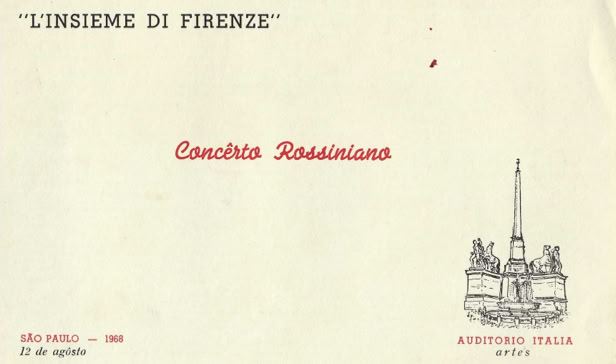
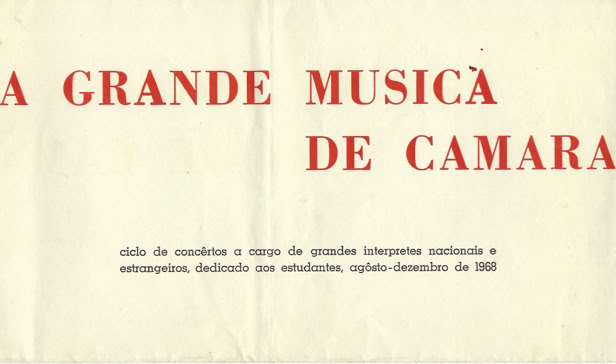
Studies on Italy-Brazil relations were marked by reflections and dialogues that followed concerts in the "Great Chamber Music" program at the Auditório Itália, a series promoted by the Italian-Brazilian Cultural Institute of São Paulo. A highlight of the program was the Rossini Concerto by L’Insieme di Firenze, prompting consideration of the dissemination of Rossini's works in Brazil based on manuscript copies uncovered in 19th-century research. Among other events, recitals by Pietro Maranca, a pianist established in Italy since 1960 and a graduate of the Monteverdi Conservatory in Bolzano, deserve mention. The Auditório Itália's programming was not limited to Italian artists and ensembles; mention should be made of the recital by Andor Foldes on September 9th, a native of Budapest. On October 29th, Paulo Affonso de Moura Ferreira organized a concert dedicated to Czechoslovak music. This concert came about as a result of the movement's contacts with the Czechoslovakian consulate in São Paulo and the acquisition of Czech publications that were used in the meetings.
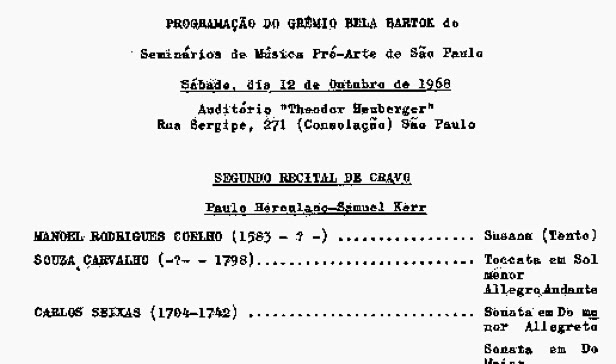
Of extraordinary significance were the events of the Grêmio Bela Bartok of Pró-Arte held in the Theodor Heuberger Auditorium, particularly those focused on early music, starting with the concert by Heloisa Fortes and José Luiz Sampaio-Hortencia on May 18th and by Paulo Gustavo Bosisio on May 25th. Pró-Arte's main contribution to musicological studies resided primarily in the field of early music, particularly the harpsichord. On October 14th and 12th, two harpsichord concerts were held by Paulo Herculano and Samuel Kerr. The second of these concerts was dedicated to Portuguese composers, including Manoel Rodrigues Coelho, Carlos Seixas, and Souza Carvalho. This concert was a landmark in the development of musicological studies concerning Portugal. On December 18th, harpsichordists offered a harpsichord recital, followed by piano recitals by Heloisa Fortes on the 12th and Amilcar Zanio on the 14th.
The attention of the members of the ND movement, corresponding to the orientation towards processes and overcoming boundaries and divisions, also led to considerations of jazz and popular music, initiating musicological studies in these areas. Among the events that motivated dialogues, the jazz and Bossa Nova recital organized by Wilson Curia on October 21st stood out.
The movement for the renewal of perspectives and procedures that we had initiated in previous years acquired legal status. As a recognized public utility society, it was able to obtain support from government agencies. Its official establishment in October 1968 was prepared through meetings, debates, conferences, and collaborations at events. Attention was focused on opening up perspectives based on the consideration of advanced trends in thought, arts and cultural studies, communication and media, information theory, and semiotics.
As part of the preparations for the official founding of the Nova Difusão movement and its Musicology Research Center as a society, meetings were held in academic directories of colleges and conservatories indicated by the Artistic Supervision Service of the State of São Paulo, including the Centro Academico Arsinis (CEAM) of the Sacred Heart of Jesus Conservatory, in an event on October 21st. Several sessions were held with music and arts teachers in gymnasiums and conservatories on the premises of the Maria Imaculada College on Avenida Paulista.
A significant event in São Paulo's cultural life in 1968 was the lecture series on art and communication by art theorist Décio Pignatari, organized by the city library. To realize this series, publications on international literature concerning communication theory and media, available in the city's libraries and university departments, were compiled. The lectures and discussions proved groundbreaking for the development of media and communication studies and for the reorientation of approaches in various disciplines. The long-simmering desire for new forms of communication, for overcoming social barriers in musical life, and for the renewal of teaching content and program design, met with growing interest not only in contemporary music but also in early music, as the latter still represented something new within a well-established, conventional repertoire of concert halls and conservatories. That same year, the music group Paraphernalia was founded by young musicians dedicated to playing early musical instruments and Renaissance music, and closely associated with the Faculty of Architecture. Through their numerous performances, they played a significant role in overcoming conventions and spreading a new repertoire.
Among the personalities who marked the reflections, cultural theoretician Décio Pignatari.llektuellen Lebens um die Jurafakultät stood out. In May and June of 1968, the arts section of the Mário de Andrade Municipal Library, with the support of the cultural department of the São Paulo Secretariat of Education and Culture, promoted the course "Art and Communication," which offered important impetus for studies and debates. In preparation for this event, the organizers compiled a list of available bibliography in São Paulo. Some of the works were already known in Portuguese editions. In 1964, The Artificial Thought by von Pierre de Latil (Ibrasa) was published, and in 1965, Language in Thought and Action by S. I. Hayakawa (São Paulo: Pioneira). The Process of Communication by K. Berlo appeared in an edition by the Alliance for Progress, as did The Strategy of Waste by Vance Packard (Ibrasa 1965).
List of works considered in the preparatory studies for the official recognition of the New Diffusion movement:
Morris, Charles Morris "Segni, linguaggio e comportamento", trad. Silvio Ceccato, Mailand: Longanesi & Co 1949); Wiener, Norbert, "Human use of human being – Cybernetics and Society", (New York: Doubleday & Co. Ins., 1954);Wiener, Norbert, Peirce, Charles Sandeers, Philosophical writings of Peirce (New ork: Dover Publications 1955); Miller, George A., Langage et communication, trad. Colette Thomas (Presses Universitaires de France 1956); Mandelbrot B, Apostel L, und Morf A., Logique, langage et théorie de l'information (Presses Universitaires de France 1957); Cherry, Colin, On human communication (New York: Sciences Editions 1959); Jakobson, Roman, Essais de linguistique generale, trad. Nicolas Ruwet (Paris, Editions de Minuit 1963); Communications – Organ der École Pratique des Hautes Études – Centre d'Ètudes de Communications de Masse (Paris: Seuil – vor allem Roland Barthes, „Rhétorique de l'image“, n° 5, 1964); Benjamin, Walter, L'oeuvre d'art à l'ère de sa réproductibilité technique“ in Oeuvrs Choisis I (Paris: Julliard 1964); Saussure, Ferdinand ,Cours de linguistique générale (Paris, Payot 1965); Eco, Uberto, L'oeuvre ouverte, trad. C. Roux de Bézieux (Paris: Editions du Seuil 1965); Hallacy, H.S., Computeers, the machines we think with (New York: Signet Books 1965); McLuhan, Marschall, Understanding media (McGraw Hill Publications 1965);Lefebvre, Henri, Le langage et la société (Paris: Gallimard 1966).
In libraries in São Paulo, works on Information Theory were consulted, in particular:
Moles, Abraham – Theorie de l'information et perception esthétique (Paris: Flammarion 1958); sobre cibernética, entre elas Wiener, Norbert, La cibernetica (Milano: Bompiani 1953); ders. Introduzione alla cibernetica (Torino: Einaudi 1953); Guilbaud, Georges T., La cybernétique (Paris, P.U.F. 1954); Ruyer, Raymond, La cybernétique et l'origine de l'information (Paris: Flammarion 1954);Cossa, Paul, La cybernétique (Paris: Masson); Ducrocq, Albert, Découverte de la cybernetique (Paris: Julliard 1955); Ashby, William Ross, Introduction á la cybernétique (Paris; Dund, 1958); Cortes Rodrígues, Hermán, Psicologia e cibernética (Buenos Aires: Siglo Veinte 1958)
The fregistration of the Nova Difusão Society, with its Center for Musicological Research, was celebrated with a conference and inaugural concert at the Maria Imaculada College auditorium on Avenida Paulista on September 15th, attended by professors of music history, folklore, and pedagogy, directors of institutions, conductors, and art critics. The inaugural concert was performed by the Madrigal das Arcadas. The program included works by Chailley, Stravinsky, Lasso, José Maurício, Guarnieri, Juan del Encina, Sweelinck, Arcadelt, Villa-Lobos, T. Morley, P. Certon, Monteverdi, and Scarlatti. From a musicological point of view, the performance of two responsories by José Maurício was highlighted. This choral group originated in the Law School at Largo de São Francisco. Formed by a group dedicated to Renaissance music, encompassing both works of contemporary musical literature and Brazilian composers inspired by folklore, as well as sacred music from all periods. It was conducted by Luís Antonio Borges, a lawyer and conductor, who had studied with Diogo Pacheco, Davi Machado, and Roberto Schnorrenberg. He represented Brazil as a singer in the Arezzo choral competition in 1964 and participated in the Cantoria Ars Sacra choir and the Collegium Musicum of São Paulo, and would be the founder of the Society of Sacred Music. A concert by the Madrigal das Arcadas that marked an era in musicological studies was the Baroque Music concert, where, alongside works by Buxtehude and Albinoni, they presented the Te Deum from Luis Alvares Pinto (1719-1789) in a reduction for choir with harpsichord accompaniment, a work discovered by Jaime Diniz. The intense relationship between the Nova Difusão movement and the Madrigal das Arcadas led to the establishment of relationships with other university choral groups, including the choir of the Manoel de Abreu academic center of medical students, which performed on October 26th, and the Ars Nova choir of the Federal University of Minas Gerais, which held concerts in São Paulo on November 15th and 17th. These relationships motivated reflections on the student choral movement within the context of considerations about conceptions of cultural diffusion, which would continue in the following years in Brazil and Germany.
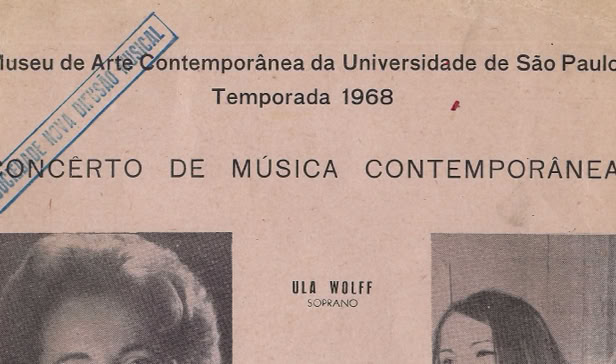
On November 19, 1968, a contemporary music concert was held as part of the second exhibition of young contemporary art at the Museum of Contemporary Art of USP (University of São Paulo). The event, promoted by Walter Zanini and organized by Paulo Affonso de Moura Ferreira and Klaus-Dieter Wolff, featured Ula Wolff (soprano), Paulo Affonso de Moura Ferreira and Valeska Hadelich. This event marked the continuation of the collaborative work with Paulo Affonso de Moura Ferreira on the Nova Difusão movement, which would last for decades. Having recently returned from Germany, and having been linked to international contemporary music circles and institutions, including those in Darmstadt, Detmold, Munich, and Warsaw, his collaboration with Nova Difusão and its Center for Musicological Research led to the beginning of relationships with international contemporary music circles, particularly in Germany.
The event opened with a presentation by Hans Joachim Koellreutter. Koellreutter's Piano Piece (1965) was performed, revealing references to Eastern musical culture. Koellreutter was in India at the time. This work highlighted the growing interest in India and the Orient in general, recalling that Martin Braunwieser, in his youth, had also dedicated himself to the study of Oriental music. This led to an awareness of the significance of studying East/West relations within the study of cultural processes, which has shaped developments over the decades. The program then featured works by two composers who have since been closely associated with cultural studies in global contexts through music: Ernst Widmer. In his lecture he highlighted the significance of the five volumes of Widmer's Ludus Brasiliensis, then director of the Bahia Music Seminars, as well as considering the significance of Heitor Alimonda's for the renewal of piano teaching in São Paulo.
On November 19, 1968, a contemporary music concert was held as part of the second exhibition of young contemporary art at the Museum of Contemporary Art of USP. The event, promoted by Walter Zanini and organized by Paulo Affonso de Moura Ferreira and Klaus-Dieter Wolff, featured Ula Wolff (soprano), Paulo Affonso de Moura Ferreira (piano), and Valeska Hadelich (voiolino). This event continued the collaborative work with Paulo Affonso de Moura Ferreira on the Nova Difusão movement, which would last for decades. Having recently returned from Germany, and having been linked to international contemporary music circles and institutions, including Darmstadt, Detmold, Munich, and Warsaw, his collaboration with Nova Difusão and its Center for Musicological Research led to the beginning of relationships with international circles dedicated to contemporary music, particularly German ones.
A Ciranda, a Modinha, and a Waltz were performed by José Penalva, relating tradition to dodecaphonism. Luigi Dallapiccola's 1948 *Quatro Liriche di Antonio Machado* was performed as an example of the significance of the Spanish poet and the art of vocal treatment by Italian composers. This was followed by a performance of John Cage's *The Wonderful Widow of Eighteen Springs* (1942) for voice and closed piano, with percussion on the piano, based on a version of James Joyce's *Finnegans Wake*. This work served to highlight Joyce's significance, not only in literature but also in musicology, demonstrating that his work already reveals techniques employed by John Cage in music.
A Ciranda, a Modinha, and a Waltz were written by José Penalva, relating tradition to dodecaphonism. Luigi Dallapiccola's 1948 Quatro Liriche di Antonio Machado was performed as an example of the significance of the Spanish poet and the art of vocal treatment by Italian composers. This was followed by a performance of John Cage's The Wonderful Widow of Eighteen Springs (1942) for voice and closed piano, with percussive effects, based on a version of James Joyce's Finnegans Wake. This work served to highlight Joyce's significance not only in literature but also in musicology, demonstrating that his work already reveals techniques employed by John Cage in music.
Boris Blacher's (1903-1975) *Francesca da Rimini op. 47*, a fragment from the *Divine Comedy* for soprano and violin, was presented. It was considered that Blacher employed in this work a variable metric that had already marked his Ornamente cycle, opus 37 for piano, from 1950/51. This technique had already been used by, among others, Daniel Jones and Joseph Schillinger. The first part of the program ended with "a piacere..." (Propositions for piano) by Kazimierz Serocki, a composer who has been repeatedly featured in contemporary music concerts in São Paulo. The three structures and their segments are the responsibility of the pianist. In the second part of the program, Franco Evenglist's sound projections were performed, in which the performer has the freedom to determine the development of both pieces, allowing for a continuum of simple and independent structures. The structures emerge connected, leading to a whole.
Based on performances of Luis de Pablo's Book for Pianist II, it was shown that the performer influences the realization of the work, since they can choose the sequence in the execution of the sound groups and the tones within them, as well as the tempo. From the work of Claudio Santoro, Intermitências I was presented, a work that offered itself as an example of compositional trends in Brazil around 1968. In it, moments of total freedom alternate with parts of great determination. In it, the piano strings are directly manipulated. Almeida Prado's Cantus Mobiles was presented. The core of the work is the Antiphon, which is followed by seven Cantos. The performer determines the order and repetitions of these Cantos.
John Cage's Six Melodies for Violin and 4’33’’ were performed. The concert concluded with miniatures by Krzysztof Penderecki. In this work, piano and violin are explored in terms of their possibilities for sound production. Pitch and duration are indeterminate, although connected. The professor from the Krakau Higher School of Music uses elements of musical notation, demonstrating the interest of the composer and theorists of the time in notational issues, corresponding to that interest in notation and writing in Brazil.
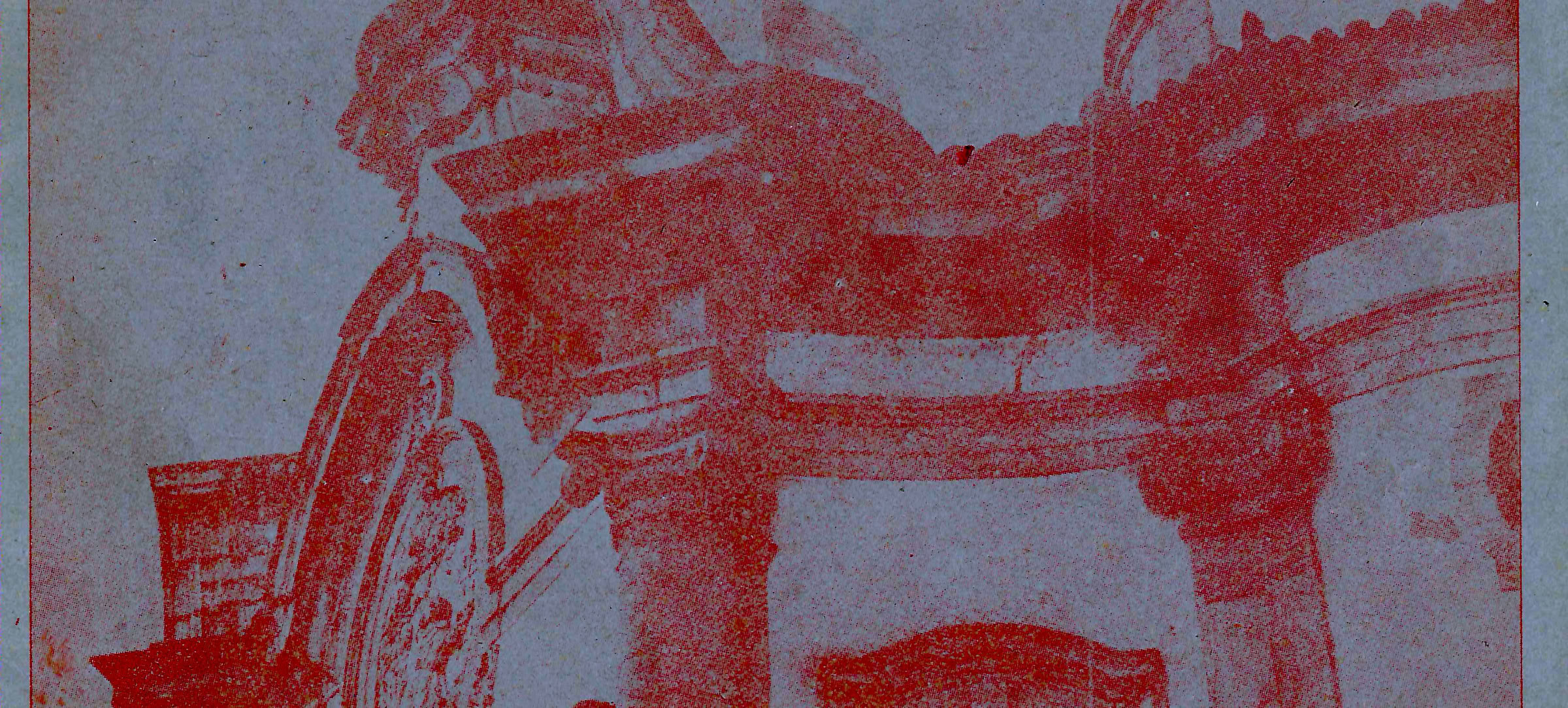
The most important musicological event of the ND movement and its Center for Musicology in 1968 was the Baroque Festival held on December 16th and 20th, 1968, at the Church of Our Lady of Fatima, with the support of the São Paulo City Hall. The concerts were performed by the madrigal and the São Paulo Chamber Orchestra under the direction of Jorge Salim and Olivier Toni. Jorge Salim had furthered his studies in Massachusetts with a scholarship from the Boston Symphony Orchestra. The objective of this concert was to continue the studies concerning Baroque conceptions and the consideration of works from Brazil's colonial past in global contexts, conducted with the São Paulo Chamber Orchestra in 1967, and corresponding to the current interest in the theme manifested in the 1968 concerts and discussed in meetings with José da Veiga Oliveira. The theoretical position of the Center for Musicological Research was to emphasize the need for differentiation in historical periodizations, and for conceptualizations of Baroque and Colonial Music, focusing attention on ecclesiastical and secular processes within global contexts and Colonialism. The first concert featured works by J.S. Bach, A. Vivaldi, the Litany of Our Lady by an anonymous author from the Paraíba Valley (from the collection of Benedito Moreira of the ND movement), and the Te Deum by José J. Emerico Lobo de Mesquita. The second concert presented works by A. Corelli, J.S. Bach, the Litany by José J. Emerico Lobo de Mesquita, and the Credo by Manoel Julião da Silva Ramos, discovered in ND research and also erroneously attributed to another researcher.
The Nova Difusão movement had Antonio Alexandre Bispo, Roberto Dante Cavalheiro Filho, and Marina Gomes as inter-departmental directors. Its board of directors was composed of representatives from various fields of knowledge: Carlos Alberto de Souza, Eduardo Villaça Pinto, Hanna Weissberger, Maria Cristina Zucchy, Norberto Amorim, Raul César Cavedon, Sueli de Fátima Bispo, and Yara Ulbrich. The Center for Research in Musicology was managed by Maria Cristina Zucchy.
68 in the Contemporary History of Intercultural Relations I
68 in the Contemporary History of Intercultural Relations II