BRASIL-EUROPA
GLOBAL STUDIES
CULTURE/NATURE

BRASIL-EUROPA
GLOBAL STUDIES
CULTURE/NATURE
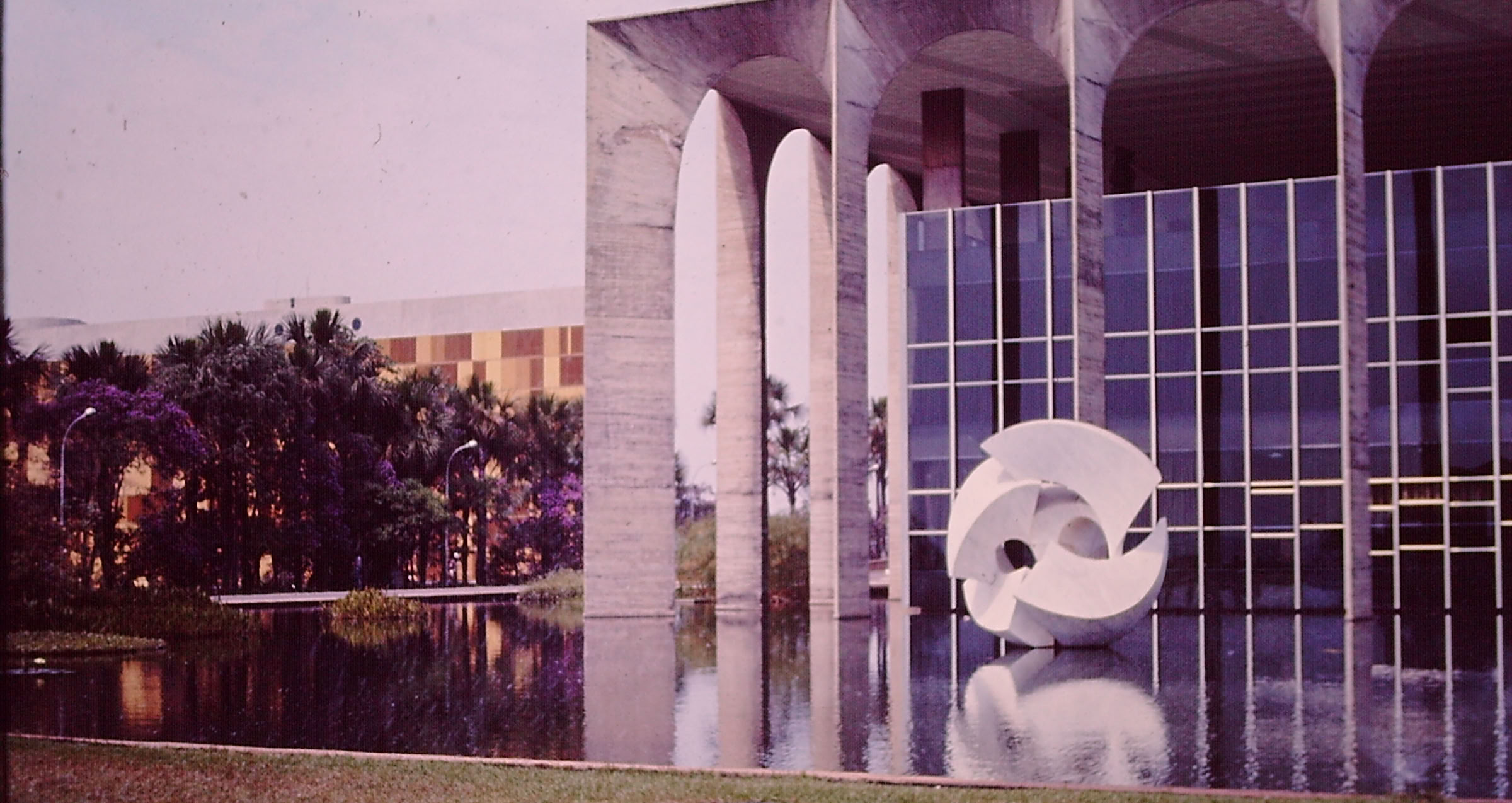
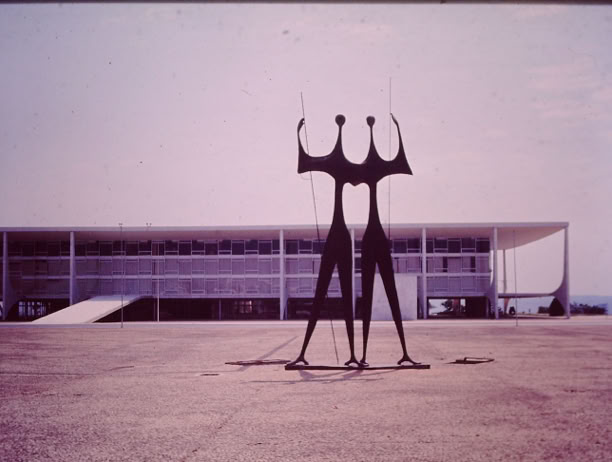
Brasília 1971
Global Studies/Culture Nature
Photo A.A. Bispo©
1971
Studies of cultural processes in global contexts
using Euro-Brazilian relations as a frame of reference
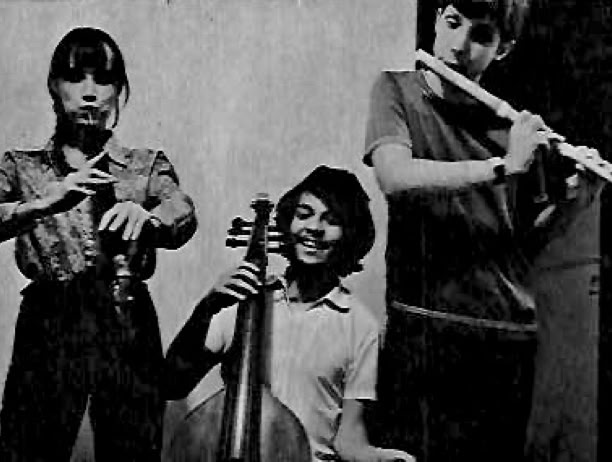
Paraphernalia 1971
Global Studies: Culture/Nature
Brasilia 1971
Global Studies: Culture/Nature
Photo A.A.Bispo©
Brasilia 1971
Global Studies: Culture/Nature
Photo A.A.Bispo©
Brasilia 1971
Global Studies: Culture/Nature
Photo A.A.Bispo©
Brasilia 1971
Global Studies: Culture/Nature
Photo A.A.Bispo©
Brasilia 1971
Global Studies: Culture/Nature
Photo A.A.Bispo©
Brasilia 1971
Global Studies: Culture/Nature
Photo A.A.Bispo©
Brasilia 1971
Global Studies: Culture/Nature
Photo: A.A.Bispo©
Brasilia 1971
Global Studies: Culture/Nature
Photo A.A.Bispo©
Brasilia 1971
Global Studies: Culture/Nature
Photo A.A.Bispo©
Brasilia 1971
Global Studies: Culture/Nature
Photo A.A.Bispo©
Brasilia 1971
Global Studies: Culture/Nature
Photo A.A.Bispo©
Brasilia 1971
Global Studies: Culture/Nature
Photo A.A.Bispo©
Brasilia 1971
Global Studies: Culture/Nature
Photo A.A.Bispo©
Brasilia 1971
Global Studies: Culture/Nature
Photo A.A.Bispo©
Cities visited on events and studies circuits
Rio de Janeiro
Rio de Janeiro, Niteroi
Bahia
Salvador
Pernambuco
Recife, Olinda
Minas Gerais
Belo Horizonte
Brasília
Brasília
Paraná
Curitiba
São Paulo
São Paulo, Itú, Campinas, Sorocaba, Presidente Prudente, São Carlos,, Santos, Atibaia, Beragança Paulista, Jundiaí, Ribeirão Preto, Araraquara, São José do Rio Preto
Topics considered
Mass communication | Media and image formation | Fashion in cultural processes | Baroque and mentality | Renewal of music education | Music in cultural research and education | History of music as a guiding subject | Music in cultural processes in the 20th century | Sensory perception and education | Renewal of teacher training | Cultural adaptation of methods: Orff and Ward | Musicology at the University | Culture/Nature and Landscape | Architecture of theaters, urban landscaping | Germany/Brazil: Music in political-cultural relations in the 20th century | Early and contemporary music | Anthroposophy and music | Eurythmy and music | Waldorf pedagogy and its cultural adaptation |
* * *
1971 was a year of opening perspectives, intense theoretical reflections and actions in socio-cultural studies, events and achievements. These initiatives marked developments in circles of progressive orientation in research and action. It was a year marked by continuities and intensification of projects and initiatives from previous years, but also by new ones, highlighting those dedicated to theoretical-cultural themes, communication, culture and urban processes, and the scientific-cultural orientation of musicological mediation in education.
Studies of mass media and communication, information, visual communication, metropolitan situations and contexts, popular culture, festivals and shows, trends in thought and actions at the international level intensified developments aimed at renewing visions and procedures in cultural studies. Overcoming compartmentalized ways of thinking, of psycho-mental narrowness, required directing attention to processes that transcend borders and delimitations.
Concepts and practices in fields of study, previously determined by categorizations of objects of study in different senses, needed to be rethought. Studies should be conducted not only through interdisciplinary collaborations, but also transdisciplinary ones, and in global contexts, from socio-cultural perspectives and from media and communication studies. In these reflections, music served as a guiding principle in the analysis of cultural processes, corresponding to the socio- and political-cultural significance of popular music and the popularity of festivals, and to the growing awareness that music is not only an expression but also an agent that moves affects and acts on psycho-mental processes. These concerns and aspirations triggered the New Diffusion (ND) movement, which, with its Center for Research in Musicology, developed intense activities in the early 1970s.
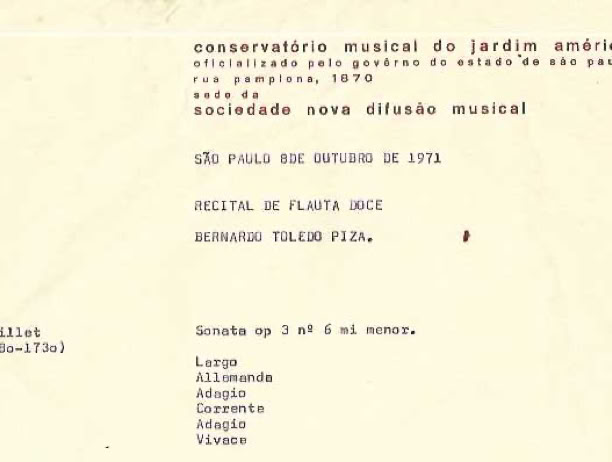
1971 was the year in which the Center for Research in Musicology of the Nova Difusão movement established its headquarters at the Jardim América Music Conservatory, assuming the scientific and cultural direction of the institution. The conservatory, recognized by the State of São Paulo through the Artistic Inspection Service, represented by Rossini Tavares de Lima, one of the most renowned folklore researchers in São Paulo, a disciple of Mário de Andrade, and director of the Museum of Popular Arts and Techniques (Folklore). Rossini Tavares de Lima supported the renewal of curricula and programs according to the guidelines of the Nova Difusão movement, initiating intense institutional cooperation, marked by meetings and debates concerning theoretical and methodological issues in cultural and musicological studies.
The restructuring of the conservatory's programs under the guidance of the Center for Musicological Research was discussed with researchers and composers in meetings and conferences, including those of Osvaldo Lacerda, Gilberto Mendes, and Willy Correa de Oliveira. The curricular and program changes were accepted by the government inspection service for conservatories. The History of Music course was expanded to three years. The third year was dedicated to 20th-century music, understood in all its expressions and contexts, not limited to advanced currents in terms of musical languages, new or avant-garde music, although the movement remained closely linked to them. Attention was directed to the contemporary in its broadest sense, to contemporaneity, an orientation developed in previous years, among others in events at the Museum of Contemporary Art in collaboration with Paulo Affonso de Moura Ferreira. One of the main initiatives was the renewal of the institution's traditional three-year teacher training courses in music initiation. The delivery of courses began to be conducted from the perspective of their suitability to cultural contexts and processes. One aspect of the debates concerning pedagogy in its close relationship with musicological research concerned the Orff and Ward methods in their insertion into global cultural and ideological contexts. Another pioneering initiative was the establishment of a Sensory Perception Laboratory and a synesthesia study group.
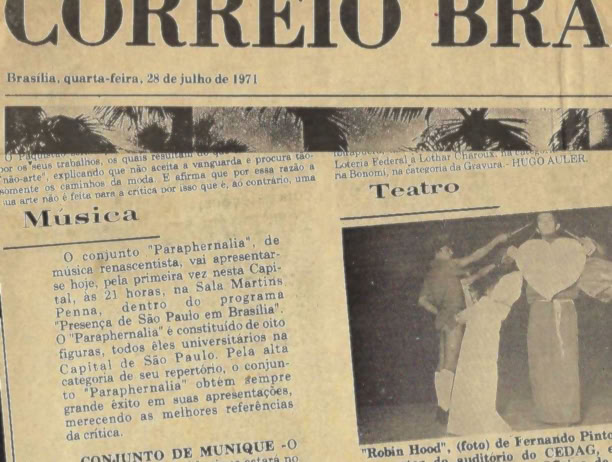
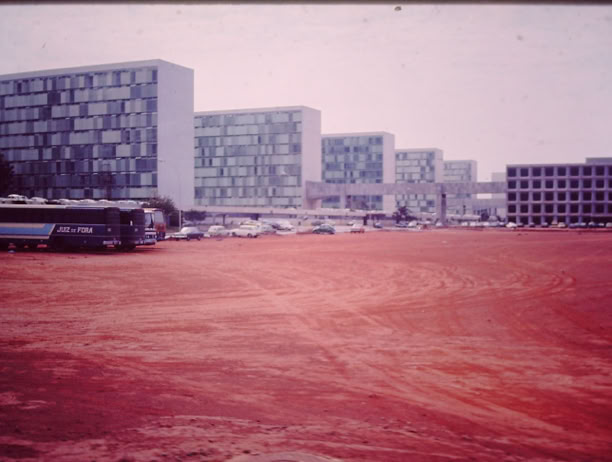
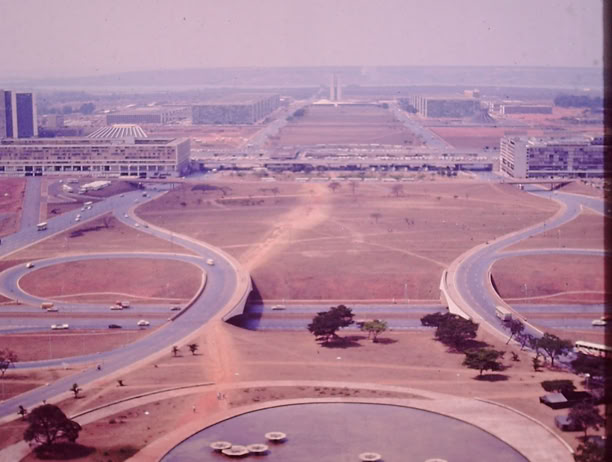
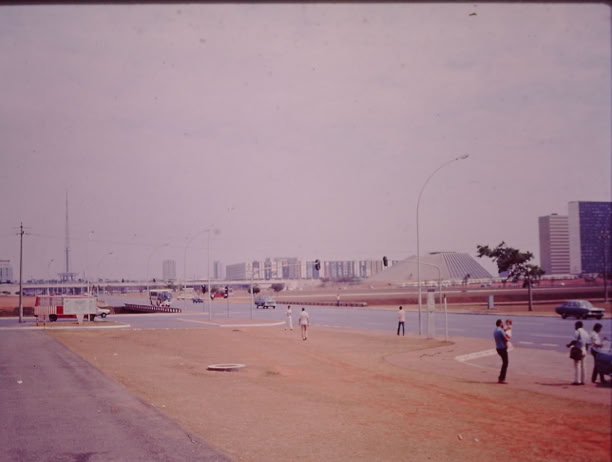
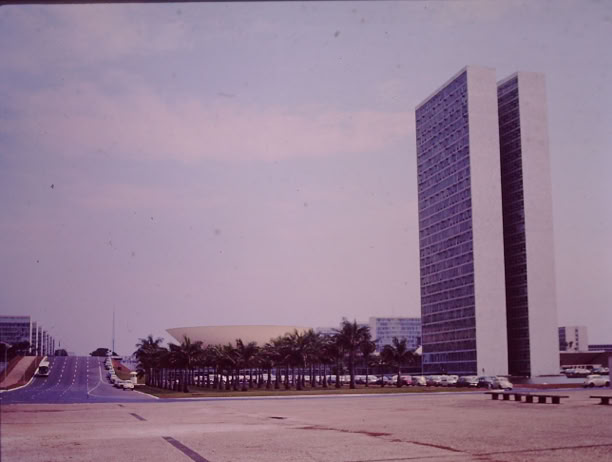
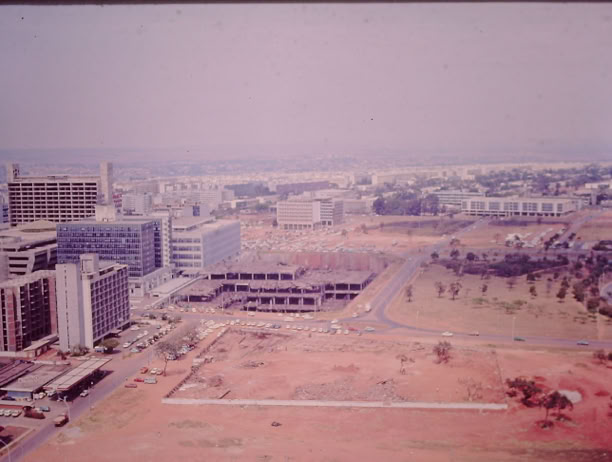
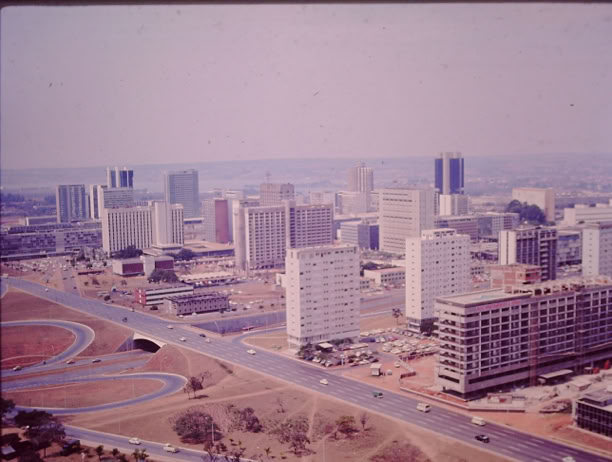
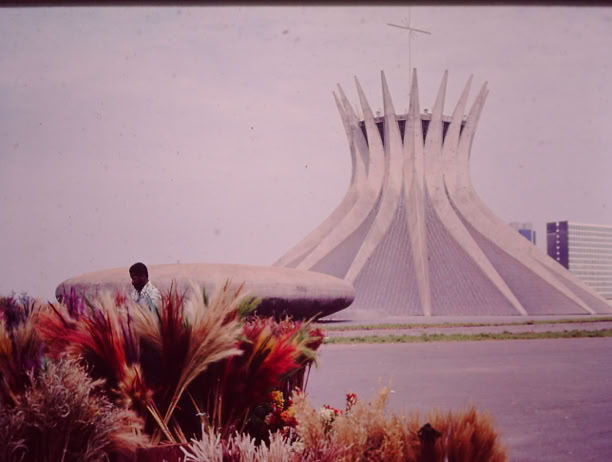
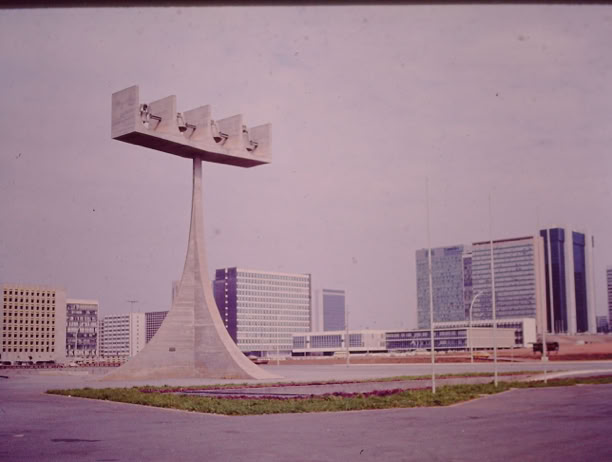
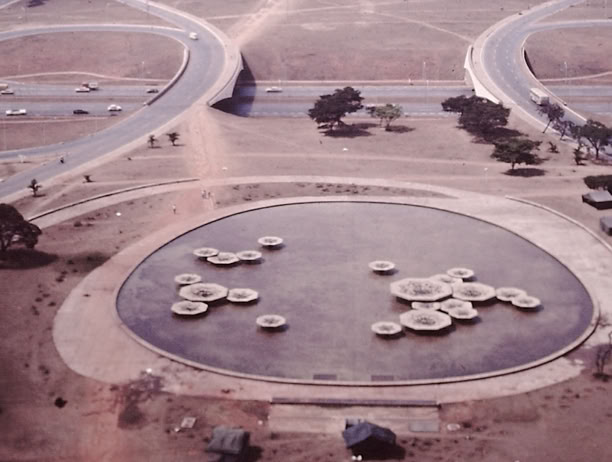
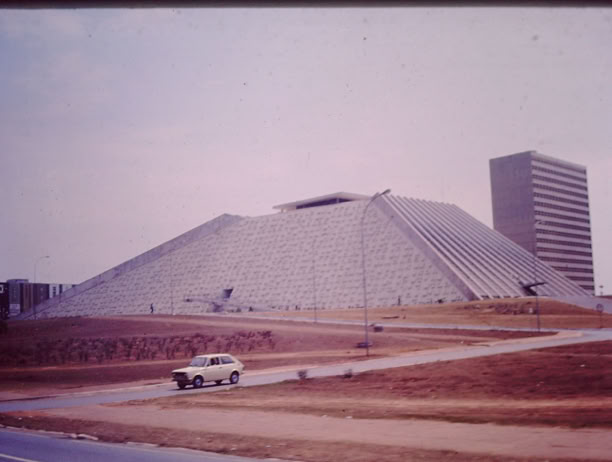
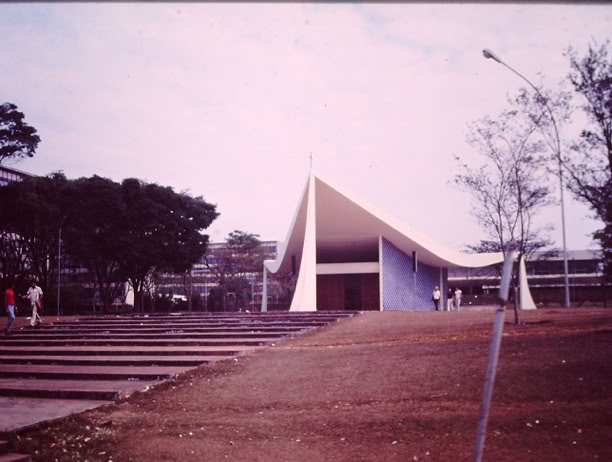
Close collaborations with the contemporary music movement led by Paulo Affonso de Moura Ferreira, who then assumed the direction of the music department at the University of Brasília, were intensified with the participation of members of the Nova Difusão movement in the event Presença de São Paulo em Brasília at the Teatro Martins Pena, promoted by the Federation of Social Assistance and Service Entities of Brasília - FEASB. In these meetings, issues of cultural studies of musical mediation interacted with those related to urbanism and green spaces, in accordance with current trends in the debates of the Council of Architecture and Urbanism of the Federal District (CAU), including the urbanization of the Cruzeiro area, where the first Mass in Brasília was celebrated. Interest in historical-musicological studies in global contexts, with special attention to early music in Brasília, was sparked by the performance of the Paraphernália ensemble of early instruments, dedicated primarily to Renaissance music. This presentation, which prompted reflection in the music department, was followed by a concert by the Bavarian State Orchestra's Wind Octet and the Bavarian Wind Quintet.
The Paraphernália ensemble, formed in 1968, developed intense activities in São Paulo in 1971, arousing interest in the music of the more distant past, particularly the Renaissance in its insertions in global contexts, in different social circles and cities. Founded in the Grêmio Bela Barok of the Pró-Arte Music Seminars, it debuted in 1968 at the Municipal Theater accompanying the Mastersingers. Led by Abel Vargas, a graduate of Pró-Arte and then an architecture student, the ensemble contributed several concerts to the Nova Difusão Autumn Festival in 1970 and performed in cities in the interior, São José dos Campos, Lins, Santos, Piracicaba in other states, Niteroi, Ouro Preto and Mariana, as well as television programs, highlighting TV Cultura, as well as at the French Music Festival in 1969, and the Ouro Preto Winter Festival. The group continued its performances in the interior of the state in 1971, including in Campinas, Ribeirão Preto, São Carlos, São José do Rio Preto, Araraquara, and Sorocaba. These occasions were used for research and networking through the Nova Difusão movement.
On March 28th, Paraphernália performed at the SECTUR Morning Meeting in a concert sponsored by the Santos Department of Tourism, Culture, and Sports. On May 29th, the ensemble performed in a concert commemorating the 40th anniversary of Pró-Arte, featuring Renaissance works from various countries and, with guest artists, French music from the 17th, 18th, and 19th centuries. The program was also held at the Alliance Française in São Paulo during the month of May. The extensive program throughout the state was promoted by the State Secretariat of Education and Culture through the efforts of Neide Carvalho, a member of the Nova Difusão movement, and cultural departments and institutions from different cities. On May 25th, they performed at the Paço Florivaldo Leal in Presidente Prudente during "Abolition Week." On June 9th, celebrating the 20th anniversary of the Centro Acadêmico Vital Brasil, they performed at the Faculty of Medicine in Sorocaba. On July 6th, the ensemble performed in an early music concert at the Teatro Castro Mendes in Campinas.
It is significant to consider the relationship between this interest in early music and German-speaking circles in São Paulo, particularly those related to Anthroposophy and the Waldorf method. On July 16th, Paraphernália, with young singers, performed in concert at the Eurythmy Hall of the Higienópolis School, presenting works from the Middle Ages, Renaissance, and 19th and 20th-century composers, concluding with G. Fauré's Cantique de Jean Racine, performed by musicians from Nova Difusão. On September 25th, at the Higienópolis School, a concert of contemporary and Baroque music took place, where members of Nova Difusão presented compositions by 20th-century German composers, their first performances in Brazil, which were the subject of studies at the Center for Musicological Research, including works by Herbert Baumann, Kurt Hessenberg, and Hans Georg Burghardt. In October, they performed at the art week promoted by the Faculdade Paulista de Música and the Normal Institute of Music, in collaboration with the State Music Commission. On October 23rd, the musicians of Paraphernália demonstrated once again that they were dedicated not only to early music but also to 20th-century music, performing works by Paul Hindemith, Hans-Ulrich Staeps, and Béla Bartók. On November 22nd, they performed at the Dr. Perdigão Municipal Theater in São Carlos.
The fascination with the Renaissance also reached circles of São Paulo's high society, assuming the Paraphernalia connotations of a hip, as evidenced by that December 2nd event in Prainha, at the inauguration of the third Sonoplan store, opened by Ronaldo Matarazzo Suplicy, with its English lawn contrasting with a beachy atmosphere, aiming to transform the location into a center for classical and pop music.
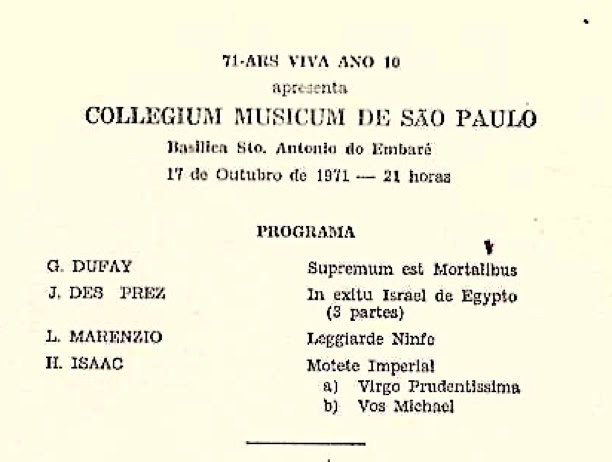
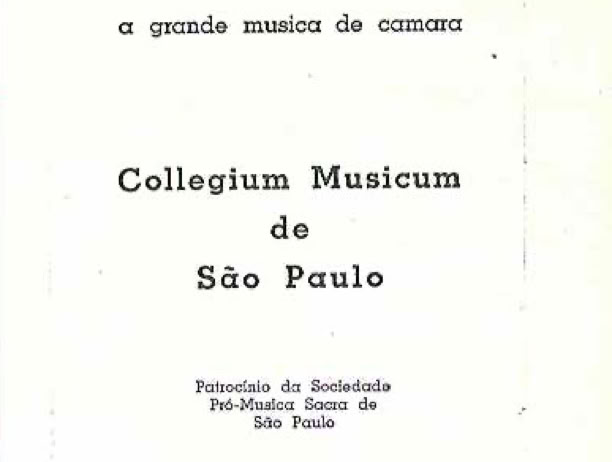
Historical-musical studies and the cultivation of Renaissance and Baroque works marked the activities of the Collegium Musicum of São Paulo, of which several members of the Nova Difusão movement were part. Under the direction of Roberto Schnorrenberg, European and North American musicological literature was studied and expressed in concerts that marked an era, in which singers and musicians from other early music organizations participated. On June 23rd, the Collegium Musicum performed works by G. Dufay, A. Holborne, L. Marenzio, H. Issak, C. Monteverdi, G. Caino, and A. Hammerschmidt. Another particularly significant concert was held on October 17th to commemorate the 10th anniversary of the Ars Viva movement in Santos, featuring works by G. Dufay, J. Des Prez, L. Marenzio, H. Isaac, C. Monteverdi, J. Shepherd, and G. Caino. Music from the more distant past was also studied and cultivated by the Sociedade Pró-Musica Sacra de São Paulo under the direction of Luis Roberto Borges, a collaborator of the Nova Difusão. On October 18th, this society promoted a concert by the Collegium Musicum at the Auditório Itália.
Of great significance was the participation of ND members in the show Build Up - Build Up Electronic Fashion Show - promoted by the Rhodia company, which, starting in August 1970, continued to be presented in 1971 at FENIT. This participation allowed for intense interaction and exchange of ideas with its promoters, conductors, musicians, popular singers, actors, and models in Rio de Janeiro and other cities in Brazil, including Salvador, Brasília, and Belo Horizonte. The dialogues with Rita Lee, the main focus as a star to be built and launched, were marked by similarities in ways of thinking, seeing, and acting, which continued in subsequent meetings, as well as in contacts with members of Os Mutantes. With Rogerio Duprat, meetings held parallel to the performances in various cities addressed the theoretical conceptions of the show, which far surpassed in their meaning that of a fashion presentation. Reflections on cultural studies in a political context such as that of Brazil under the military regime were initiated, among others, by the singer Juca Chaves.
Issues related to the Black movement in cultural studies were discussed with members of the Coral Criolo choir. The hours during performances in different cities were used for studies in institutions, libraries, and museums, and for networking with intellectuals, researchers, and musicians. Among these, the National Library and the library of the School of Music at the Federal University of Rio de Janeiro, as well as the Folklore Museum Joaquim Ribeiro, stood out in Rio de Janeiro. In Salvador, parallel to the performances at the Castro Alves Theater, meetings were organized at the Federal University of Bahia by professors and members of the Bahia Composers Group who were already involved with Nova Difusão movement in São Paulo. In Brasília, Paulo Affonso de Moura Ferreira, continuing his close ties with the ND movement, organized meetings at the University. In Belo Horizonte, dialogues were conducted jointly with Rogério Duprat with professors from the School of Music at the Federal University of Minas Gerais.